
Worldwide, cosmetic dentistry is no longer a luxury trend: reports show the global cosmetic dentistry market is worth $30+ billion, and veneers and crowns are two of the most commonly chosen treatments. Dental veneers are especially popular for smile makeovers, while crowns remain one of the most used solutions to save and strengthen damaged teeth.
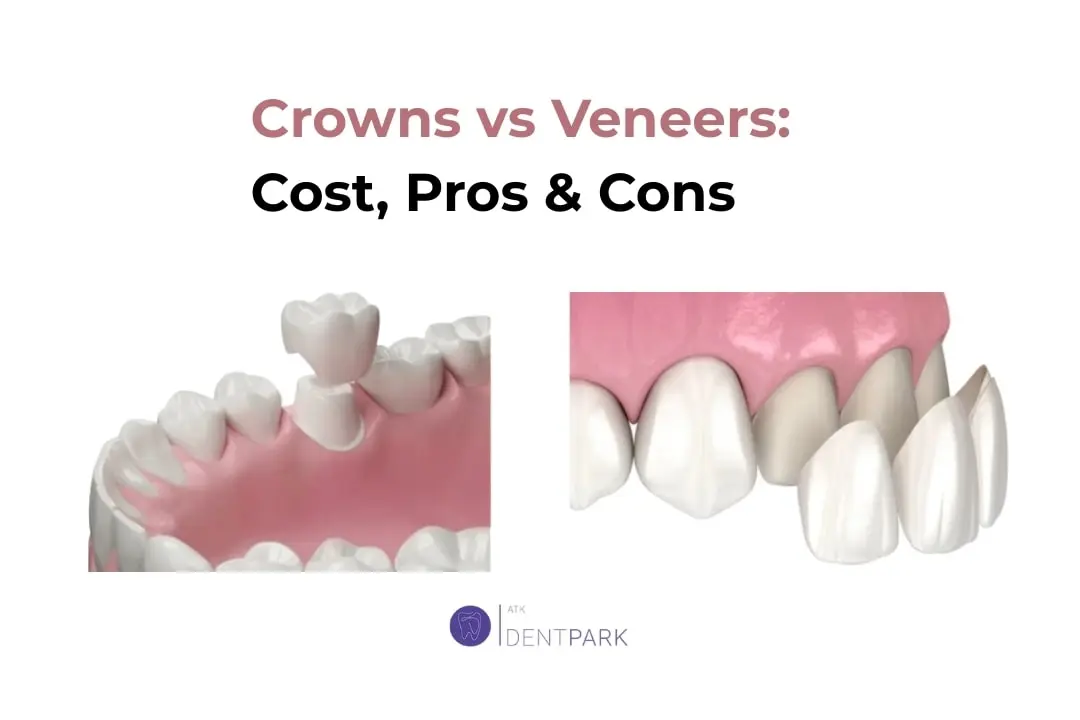
So, this isn't really about 'Hollywood teeth'. It's about understanding what your tooth needs and choosing the option that works best for you. Below, we break it down clearly and simply.
Dental crowns are basically protective caps that cover a damaged or weakened tooth and bring back its shape, strength and look. We usually use for a tooth that is badly worn, cracked, heavily filled or after a root canal.
Sometimes a tooth is just too tired to survive on its own. It might be cracked, worn down from years of chewing, or filled so many times that there's barely any tooth left. In those cases, a dental cap is like putting a strong jacket over the tooth so it can keep doing its job without breaking.
We also use porcelain crowns a lot after root canal treatment because those teeth lose their natural strength and can snap if they're left unprotected, especially the back teeth that take all the pressure. For front teeth, it's often about fixing a shape, colour, or visible break so you feel confident when you smile. So, crowns aren't about making teeth fancy, they're about saving them, protecting them and letting you use them comfortably again.
Porcelain crowns are usually the go-to choice when patients care a lot about looks. They reflect light like natural teeth and blend in nicely, which is why we often recommend them for front teeth where the smile really shows.
Zirconia crowns are all about strength. If you grind your teeth or need a crown on a back tooth that does most of the chewing, zirconia holds up extremely well and still looks clean and modern.
Porcelain-fused-to-metal crowns sit somewhere in between. They have a strong metal core with porcelain on top, so you get durability with a decent appearance, although over time the metal edge can sometimes show near the gum.
Metal crowns are the toughest of all and almost never crack, but since they don't look like natural teeth, we mostly use them on back teeth that no one sees.
Temporary crowns are just that, temporary. We place them to protect your tooth and keep things comfortable while your final crown is being custom made.
A dental crown looks just like a natural tooth. It's shaped to match your bite and coloured to blend in with the teeth around it, so most people can't tell it's there. Once it's in place, you feel like the cap is your natural tooth.
First, we numb the tooth and the surrounding area. Then we clean the tooth really well, removing decay, old fillings or weak parts, and gently shape it so the crown can sit securely on top. Nothing extreme, just enough to give the crown a stable base.
Once the tooth is ready, we take a detailed impression or a digital scan. This is important because your crown is custom-made; it has to match your bite, your other teeth and even your smile. After that, we place a temporary crown. It's not just for looks, it protects the tooth from sensitivity, keeps food out and lets you chew normally while you wait.
When the final dental crown comes back from the lab, we remove the temporary one and try the new crown on first. We check how it feels when you bite, how it looks next to your other teeth and whether it's comfortable. If something feels even slightly off, we adjust it. Only when everything feels right do we bond it permanently.
Dental veneers are thin, custom-made shells that are placed on the front surface of your teeth to improve how they look. I usually explain them to patients as a way to refresh your smile without touching the whole tooth; we only work on the visible part.
We usually use them when someone wants a visible change in their smile without major dental work. Here's what we most often use porcelain veneers for:
Veneers look like your real teeth! Honestly, that is the whole point. They're thin and smooth, and they're shaped to fit your smile so nothing feels or looks out of place. When the colour is chosen well, people usually don't realise!
| Comparison | Veneers | Crowns |
| Coverage | Front surface only | Entire tooth |
| Tooth removal | Very minimal | More tooth removal |
| Main use | Cosmetic improvement | Protection + strength |
| Best for | Front teeth | Front and back teeth |
| Durability | Strong but thinner | Very strong |
| When chosen | Teeth mostly healthy | Teeth badly damaged |
Veneers are a gentle option; they sit only on the front of the tooth, so we leave most of your natural tooth exactly as it is.
Dental caps are a different story. They cover the tooth completely, all the way around, because the tooth needs support, not just a nicer look. If a tooth is weak, cracked or has had a lot of work done before, a crown acts like a protective shell. So the real difference is this: veneers enhance, and crowns protect and strengthen.
When a front tooth is in excellent shape and you just want it to look better, veneers are usually the easier and lighter option. They fix things like colour, shape or small flaws without touching much of the natural tooth. Crowns come into play when the tooth has been through a lot, if it's broken, weakened or has big fillings and needs real support, not just a cosmetic upgrade.
Before choosing between veneers and crowns, it helps to understand what each option is good at and where it has limits. Both can improve your smile, but they work in different ways and suit different situations.
I usually tell patients this: we follow the tooth, not the trend. If the tooth is healthy and the issue is mostly cosmetic, veneers are often enough. If the tooth feels weak or has a history of damage, a crown is the safer choice for the long run.
For veneers, many dental clinics in Turkey quote around £150 – £300 ($180 – $350) per tooth for porcelain or high-quality options, though cheaper or premium materials can shift that range a bit. The cost of porcelain veneers and crowns in Turkey can be more affordable compared to many other countries. Prices vary depending on the material used, the dentist’s experience and the complexity of your case.
Yes, you can get porcelain veneers and zirconia crowns in Antalya at ATK Dentpark. The clinic offers porcelain veneers and zirconium/porcelain crowns as part of its smile design services, using modern equipment and experienced dentists.
Patients often mention airport pickup, comfortable stays and a friendly team that makes the process feel more like self-care than a medical visit.
If you're considering cosmetic dentistry combined with travel, ATK Dentpark Clinic is one of the options in Turkey.
You can contact for detailed info.
Porcelain veneers and crowns are very resistant to discolouration. Drinks such as coffee, tea or red wine can stain natural teeth, while porcelain surfaces retain their colour for a long period. Composite veneers, however, are more easily absorbed by outside factors, such as a sponge, and can yellow with time.
No. A crown application requires the whole tooth to be shaved down and reshaped because the crown covers the tooth 360 degrees. Veneers, however, are only placed on the facing surface and usually only require the removal of a very thin layer of enamel. Thus, veneers are a more conservative choice in terms of conserving healthy tooth tissue.
Yes. Many treatment plans combine the use of crowns and veneers. For example, a broken rear tooth that is subjected to biting forces may be reinforced with a crown, whilst veneers might be chosen to improve the aesthetic appearance of front teeth. This is how to give the remedy every tooth requires.
Crowns are preferred when big cavities, significant fractures or weaknesses are present due to root canal therapy. This is because a crown covers the tooth entirely, like a shield, and supports it structurally. However, veneers are mostly used to repair aesthetic concerns, including discolouration, minor fractures, imperfections or gaps between teeth. Crowns are used if you need to strengthen. Veneers are selected if you want to increase aesthetics.